


Dachshund (Teckel)
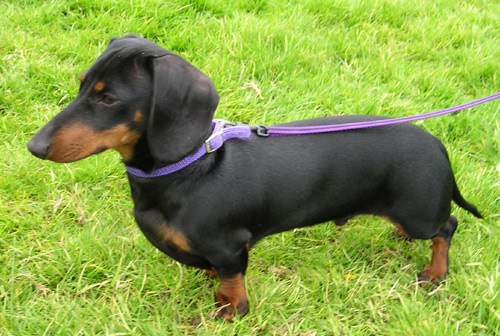
The "sausage dog". Long body, short legs. A brave hunter dressed up as a sweetheart. Independent, stubborn character. Three coat varieties (smooth/wire/long) and two sizes.
Foto: Wikipedia Commons · CC BY-SA
Mizuu editorial teamupdated on October 14, 2026Not yet reviewed by a vet. Are you a vet? Review itReport an error
Ideal for
- Families with the patience to train
- Flats
- Active older people
Reconsider if
- ×Homes with stairs (back risk)
- ×Very young children
- ×Anyone who can tolerate frequent barking
Notify me when a Dachshund (Teckel) is up for adoption
We'll only email you when a verified rescue posts one available. No spam, unsubscribe in 1 click.
We'll only use your email for this alert. More info in our privacy policy.
Is the Dachshund (Teckel) a good match for you?
Indicative rating from 1 (low) to 5 (high).
Estimated cost of ownership
45-80 €/month
Food 18-30 €, veterinary provision 15-30 € (risk of back surgery), ramp/harness and accessories 5-10 €, deworming 8-12 €.
History and origin
Bred in Germany during the 15th-16th centuries to hunt badgers underground: "Dachs" (badger) + "Hund" (dog). The elongated body was designed to enter burrows. Courage out of all proportion to its size.
Recognised by the FCI within Group 9 (companion dogs). Its small size makes flat living easy, but "small" is not the same as "needs no training": small dog syndrome (excessive barking, fear, reactivity) is common when it isn't given the same routine as a large dog.
Temperament and character
Brave, alert, independent. Devoted to one main person. A barker. Hard to house-train (stubborn). Needs daily mental stimulation — scent games, food-stuffed Kongs and short trick sessions channel its energy better than physical exercise alone. Responds best to positive reinforcement: physical punishment breeds fear, anxiety and reactivity — coercive methods are NOT recommended by veterinary behaviourists. Sensitive to its family's mood: it picks up on tension and catches it.
Living together
Children: with careful older children. Other dogs: variable. Cats: it depends.
Life stages of the Dachshund (Teckel)
Each stage has its own care priorities. Life expectancy: 12-16 años.
Puppy
0-9 months
Protect the spine from the start: avoid jumps and stairs, use ramps; weight control and socialisation.
Junior
9 months-1.5 years
Build back musculature with appropriate exercise; keep weight low so as not to overload the back.
Adult
1.5-9 years
Slipped disc prevention (its greatest risk due to the long back), strict obesity control and eye examination.
Senior
9+ years
Neurological monitoring of the spine, weight maintenance and management of arthritis and vision.
Care
Exercise 30-60 min/day. WEIGHT CONTROL is critical (excess weight → slipped disc). Avoid stairs and jumping. Brushing according to variety. Training with patience.
Feeding: quality food suited to life stage (puppy/adult/senior) and size. Weight control: obesity is the leading preventable cause of joint problems.
Vet: annual check-up with preventive blood work from age 5; twice a year from 8.
Care in detail
Nutrition
Quality food with calorie control. Weight is the number one factor in protecting its spine: keep it lean for life.
Grooming
According to variety: smooth coat needs weekly brushing; wire coat requires stripping; long coat, brushing 2-3 times a week.
Training
Independent and headstrong; house-training can be a struggle. Patience, consistency and positive reinforcement. Prone to barking.
Exercise
30-60 min/day of walking on the flat. Avoid stairs, jumps and terrain that strains the back.
Breed-specific health
Intervertebral disc disease (25% affected). Obesity. Epilepsy. Diabetes. Retinal atrophy. Life expectancy 12-16 years. Life expectancy 12-16 years with appropriate care. If you go to a breeder, ask for the parents' health tests relevant to the breed. When adopting, ask the rescue for a vet report on the current state of health.
Health predispositions for this breed
Conditions this breed is more predisposed to. Knowing about them helps with prevention and early detection. A predisposition does not mean the animal will develop them.
Common diseases in dogs
Learn the symptoms, prevention and when to see the vet. Reviewed indicative information that does not replace a veterinary consultation.
Screening and prevention for the Dachshund (Teckel)
Recommended tests and screenings
- Neurological/spinal assessment (intervertebral disc disease)
- Ophthalmic examination (retinal atrophy)
- Blood work including blood glucose (diabetes)
- Body weight monitoring
- Dental check
Prevention
Strict weight control (excess weight triggers slipped discs), avoiding stairs and jumps off sofas/beds (use ramps), and using a harness rather than a collar. Slipped disc affects up to 1 in 4 individuals.
Check-up schedule
Annual check-up; every six months from age 8 or with any history of back problems.
Warning signs
- !Refusing to move, arched back or yelping when picked up (disc emergency)
- !Weakness or dragging of the hind legs
- !Increased thirst/urination and weight loss (diabetes)
- !Stumbling or bumping into things (retinal problems)
Dachshund (Teckel) gallery
Frequently asked questions about the Dachshund (Teckel)
How long does a Dachshund (Teckel) live?
▾
How much does a Dachshund (Teckel) weigh?
▾
Where does the Dachshund (Teckel) breed come from?
▾
How much exercise does a Dachshund (Teckel) need?
▾
Is the Dachshund (Teckel) good with children?
▾
Who is the Dachshund (Teckel) NOT recommended for?
▾
What health problems does the Dachshund (Teckel) have?
▾
Why do stairs and jumping need to be avoided?
▾
Is it hard to train?
▾
Is it good with children?
▾
Does it bark a lot?
▾
Related and similar breeds
Learn more about dogs
Practical veterinary guides to support your Dachshund (Teckel).
Sources and references
Content compiled from official breed standards and leading veterinary sources.
Do you have a Dachshund (Teckel)?
Add them to Mizuu and we will remind you what is due for their breed and age: Neurological/spinal assessment (intervertebral disc disease), check-ups and vaccines.
Add my Dachshund (Teckel)Free. Create your account in a minute and come back here.
Want to adopt a dachshund (teckel)?
There are dachshund (teckel)s in rescue shelters looking for a family. Filter by breed in the catalogue.

