

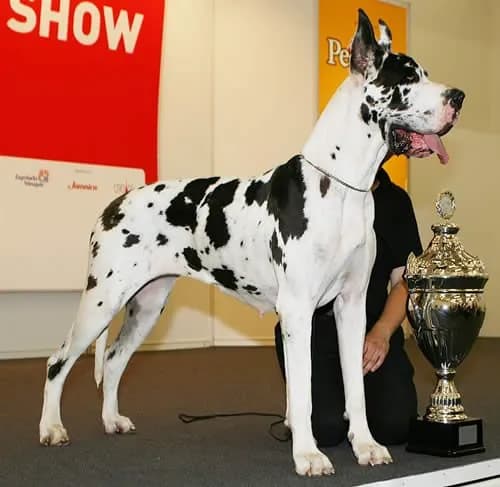
Gran Danés
An elegant giant. The "Apollo of dogs". A sweet, patient character, a "giant with a puppy's heart". A short life like other giants. Needs plenty of space.
Foto: Wikipedia Commons · CC BY-SA
Ideal for
- ✓Families with plenty of space
- ✓Those seeking a sweet giant
- ✓Calm households
Reconsider if
- ×Small flats
- ×Extreme climates
- ×Those who cannot accept a short life
Notify me when a Gran Danés is up for adoption
We'll only email you when a verified rescue posts one available. No spam, unsubscribe in 1 click.
We'll only use your email for this alert. More info in our privacy policy.
Is the Gran Danés a good match for you?
Indicative rating from 1 (low) to 5 (high).
💶 Estimated cost of ownership
150-250 €/month
It is a giant: the specific food is the major cost (60-100 €), with doses of antiparasitics and medication calculated by weight, which are more expensive (20-30 €). Pro-rated vaccinations and a check-up with cardiology (25-40 €), health insurance advisable given the cost of its emergencies such as bloat (20-40 €), and a reserve for major veterinary expenses (surgeries, gastropexy).
History and origin
Despite the name "Great Dane" (its origin is unclear), it was bred in Germany to hunt wild boar and as a noble dog. Standardised in the 19th century.
Recognised by the FCI within group 2 (molossers). It is found on farms and agricultural holdings as a guardian, as well as in homes with space. Adults live to 7-10 years: the short average lifespan is a consequence of the extreme size and calls for specific care.
Temperament and character
Sweet, patient, sociable. Attached to the family. Some individuals are shy: socialise a lot. Excellent with children. Needs daily mental stimulation — scent games, food-stuffed Kongs and short tricks channel its energy better than physical exercise alone. It responds best to positive reinforcement: physical punishment breeds fear, anxiety and reactivity — coercive methods are NOT recommended by veterinary behaviourists. Sensitive to its family's mood: it detects tension and picks up on it.
Living together
Children: excellent. Other dogs: sociable. Cats: good.
Life stages of the Gran Danés
Each stage has its own care priorities. Life expectancy: 7-10 años.
Puppy
0-18 months
Very controlled bone growth, giant-breed diet and socialisation.
Junior
18 months-2.5 years
Low-impact exercise and cervical monitoring (Wobbler).
Adult
2.5-5 years
Prevention of gastric torsion and cardiac screening (DCM).
Senior
5+ years
Close cardiac, joint and oncological monitoring.
Care
Exercise: 45-60 min/day split into at least 2 sessions. Calm walks + mental play.
Brushing: 2-3 times/week; intensive during the moults (spring and autumn).
Feeding: quality food suited to its life stage (puppy/adult/senior) and size. Weight control: obesity is the main avoidable cause of joint problems.
Vet: annual check-up with preventive blood work from age 5 (7 years in giants); twice a year from age 8.
Moderate exercise (1 h/day), avoiding jumps during growth. Raised feeder. Padded bed (calluses). Weight control.
Care in detail
🍽️ Nutrition
Food specific to giant breeds, especially at the puppy stage, for slow, controlled growth that protects bones and joints. Food split into several meals with a raised feeder and rest around mealtimes to reduce the risk of gastric torsion.
✂️ Grooming
Short, easy-care coat: brushing 2-3 times a week, more during moults. It needs a large, padded bed to prevent calluses because of its weight, and attention to the pads and joints.
🎓 Training
Docile and intelligent, it learns well with positive methods; it is essential to train it as a puppy because its adult size makes an ill-mannered dog unmanageable. Extensive socialisation for the shyer individuals.
🏃 Exercise
Moderate exercise, around 45-60 min a day in calm walks, avoiding jumps and overexertion during growth to protect its joints.
Breed-specific health
Bloat (high risk). Dilated cardiomyopathy. Dysplasia. Osteosarcoma. Wobbler syndrome. Life expectancy 7-10 years. Life expectancy 7-10 years with proper care. Pre-breeding tests recommended at responsible breeders (dysplasia + cardiac + ophthalmology according to the breed's conditions). When adopting, ask the shelter for a vet report on the current state of health.
🩺 Health predispositions of this breed
Conditions this breed is more predisposed to. Knowing about them helps with prevention and early detection. A predisposition does not mean the animal will develop them.
Common diseases in dogs
Learn the symptoms, prevention and when to see the vet. Reviewed indicative information that does not replace a veterinary consultation.
Screening and prevention for the Gran Danés
Recommended tests and screenings
- ✓Echocardiography/cardiology (dilated cardiomyopathy)
- ✓Radiography for hip and elbow dysplasia
- ✓Cervical MRI/radiography if Wobbler syndrome is suspected
- ✓Assessment of gastric torsion (bloat) risk and the option of preventive gastropexy
- ✓Thyroid tests and osteosarcoma monitoring in older individuals
Prevention
Prevention of bloat (gastric torsion), the breed's main fatal emergency: split the food into several meals, use a raised feeder, avoid intense exercise just before and after eating, and consider a preventive gastropexy. Controlled growth with a diet specific to giant breeds and weight control.
Check-up schedule
Veterinary check-up with annual cardiac assessment; because of its short life expectancy, preventive blood work as early as age 5 and two visits a year from ages 6-7.
Warning signs
- !A swollen, hard abdomen, unproductive attempts to vomit and restlessness (gastric torsion, a life-threatening EMERGENCY)
- !Coughing, fatigue, fainting or exercise intolerance (cardiomyopathy)
- !A wobbly gait or hind-end incoordination (Wobbler syndrome)
- !Persistent lameness or swelling in one limb (osteosarcoma)
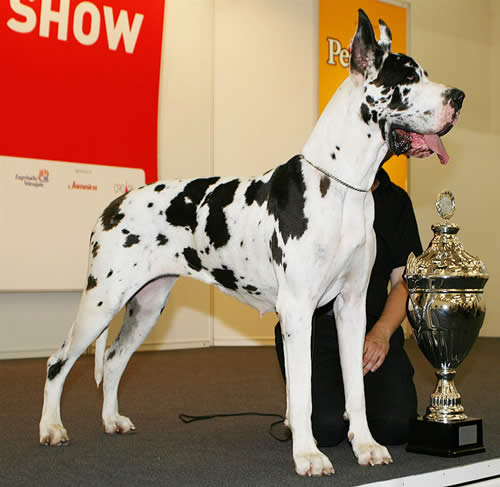
Gran Danés gallery
Frequently asked questions about the Gran Danés
How long does a Gran Danés live?
▾
How much does a Gran Danés weigh?
▾
Where does the Gran Danés breed come from?
▾
How much exercise does a Gran Danés need?
▾
Is the Gran Danés good with children?
▾
Who is the Gran Danés NOT recommended for?
▾
What health problems does the Gran Danés have?
▾
What is bloat and why is it so dangerous in the Great Dane?
▾
Why does it live so short a life?
▾
Can it live in a flat?
▾
Is it good with children?
▾
How much exercise does a Great Dane puppy need?
▾
Related and similar breeds
Learn more about dogs
Practical veterinary guides to support your Gran Danés.
Sources and references
Content compiled from official breed standards and leading veterinary sources.
Want to adopt a gran danés?
There are gran danéss in rescue shelters looking for a family. Filter by breed in the catalogue.