


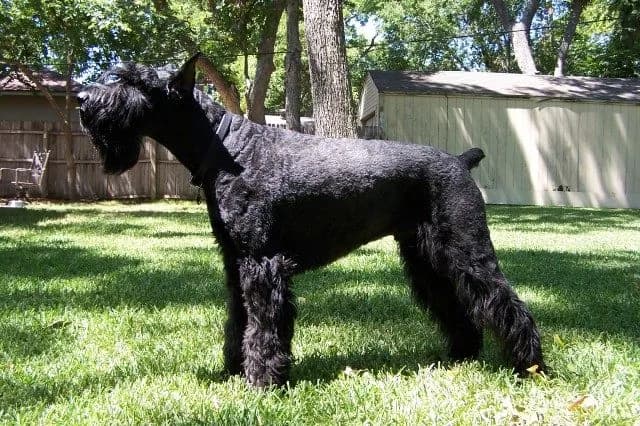
Schnauzer Gigante
The largest of the three schnauzers. A traditional German guardian. Balanced, loyal and watchful temperament. Hypoallergenic. Needs firm training.
Foto: Wikipedia Commons · CC BY-SA
Mizuu editorial teamupdated on October 14, 2026Not yet reviewed by a vet. Are you a vet? Review itReport an error
Ideal for
- Very active families with experience
- Homes with a garden
- Allergy sufferers
Reconsider if
- ×Flats without exercise
- ×Beginners
Let me know when there are dogs for adoption
We only write when a verified shelter posts one. One email a day at most.
Is the Schnauzer Gigante a good match for you?
Indicative rating from 1 (low) to 5 (high).
Estimated cost of ownership
75-130 €/month
Food for large breeds €40-65; grooming with hand-stripping (pro-rated) €15-25; parasite control €12-20; pro-rated vaccinations and check-ups €18-28. Its size makes medication and anaesthesia more expensive.
History and origin
Germany, 15th-16th century, a large farm dog from Bavaria and Württemberg. Guardian of the beer carts. Re-established at the start of the 20th century.
Recognised by the FCI in Group 2 (Pinscher and Schnauzer, Molossoid and Swiss Mountain and Cattle Dogs), standard no. 181. It is a large working dog (60-70 cm at the withers, 35-50 kg): it needs intense daily exercise, consistent training and early socialisation; it does not suit a flat without activity.
Temperament and character
Balanced, watchful and loyal. Devoted to its family. Reserved with strangers. Intelligent and hard-working. It needs daily mental stimulation — scent games, food-stuffed Kongs and short trick sessions channel its energy better than physical exercise alone. It responds best to positive reinforcement: physical punishment creates fear, anxiety and reactivity — coercive methods are NOT recommended by veterinary behaviourists. Sensitive to its family's mood: it picks up on tension and mirrors it.
Living together
Children: good with its own. Other dogs: dominant with the same sex. Cats: with socialisation.
Life stages of the Schnauzer Gigante
Each stage has its own care priorities. Life expectancy: 11-13 años.
Puppy
0-1 year
Socialisation and early obedience (a dominant, working breed); controlled bone growth.
Young
1-2 years
Plenty of physical and mental exercise; hip radiographs; thyroid baseline; wiry coat management (hand-stripping).
Adult
2-7 years
Split meals (gastric torsion); thyroid monitoring; retinal examination; monitoring for digital tumours.
Senior
7+ years
Monitoring for tumours (digital carcinoma, osteosarcoma); thyroid, eye and joint monitoring.
Care
Exercise 1.5-2 h/day. Weekly brushing plus hand-stripping every 2 months. Beard cleaning. Firm, positive training.
Feeding: quality food matched to its life stage (puppy/adult/senior) and size. Weight control: obesity is the leading avoidable cause of joint problems.
Vet: annual check-up with preventive blood work from age 5; twice a year from 7 (large breeds age sooner).
Care in detail
Nutrition
Quality food for large active breeds, adjusted to its high energy expenditure. Ration split into 2 meals with rest afterwards to reduce the risk of gastric torsion.
Grooming
Wiry coat that requires hand-stripping every 2 months and weekly brushing; it sheds very little. Clean the beard after eating and drinking to avoid odours and infections.
Training
Highly intelligent and hard-working; it needs firm, positive training and early socialisation. It is a guardian that requires experience and a constant occupation.
Exercise
Very high: 1.5-2 hours daily of physical and mental exercise. Without enough activity it develops problem behaviours.
Breed-specific health
Dysplasia. Bloat. Hypothyroidism. Cataracts. Cancer. Life expectancy 11-13 years. If you go to a breeder, ask for the parents' health tests relevant to the breed. When adopting, ask the shelter for a vet report on the current state of health.
Health predispositions for this breed
Conditions this breed is more predisposed to. Knowing about them helps with prevention and early detection. A predisposition does not mean the animal will develop them.
Common diseases in dogs
Learn the symptoms, prevention and when to see the vet. Indicative information that does not replace a veterinary consultation.
Screening and prevention for the Schnauzer Gigante
Recommended tests and screenings
- Hip and elbow dysplasia radiographs
- Thyroid function (T4/TSH)
- Ophthalmological examination (cataracts)
- Echocardiography
- Full blood count and biochemistry
Prevention
Plenty of exercise and mental work for its high energy; split meals with rest afterwards to guard against bloat; weight control, thyroid monitoring and checking of the skin and toes given its predisposition to tumours.
Check-up schedule
Annual check-up with blood tests and thyroid profile; periodic joint and eye monitoring.
Warning signs
- !Swollen abdomen with unproductive retching (gastric torsion, emergency)
- !Lameness or stiffness after exercise
- !Lethargy, weight gain or hair loss (hypothyroidism)
- !Skin lumps or swelling of a toe (possible tumour)
- !Cloudy vision or an opaque eye (cataracts)
Schnauzer Gigante gallery

Frequently asked questions about the Schnauzer Gigante
How long does a Schnauzer Gigante live?
▾
How much does a Schnauzer Gigante weigh?
▾
Where does the Schnauzer Gigante breed come from?
▾
How much exercise does a Schnauzer Gigante need?
▾
Is the Schnauzer Gigante good with children?
▾
Who is the Schnauzer Gigante NOT recommended for?
▾
What health problems does the Schnauzer Gigante have?
▾
Is it hypoallergenic?
▾
Is it suitable for beginners?
▾
How much exercise does it need?
▾
How often does it need hand-stripping?
▾
Is it a good guard dog?
▾
Related and similar breeds
Learn more about dogs
Practical veterinary guides to support your Schnauzer Gigante.
Sources and references
Content compiled from official breed standards and leading veterinary sources.
Do you have a Schnauzer Gigante?
Add them to Mizuu and we will remind you what is due for their breed and age: Hip and elbow dysplasia radiographs, check-ups and vaccines.
Add my Schnauzer GiganteFree. Create your account in a minute and come back here.
Want to adopt a schnauzer gigante?
There are schnauzer gigantes in Spanish rescue shelters looking for a family. Filter by breed in the catalogue.

