


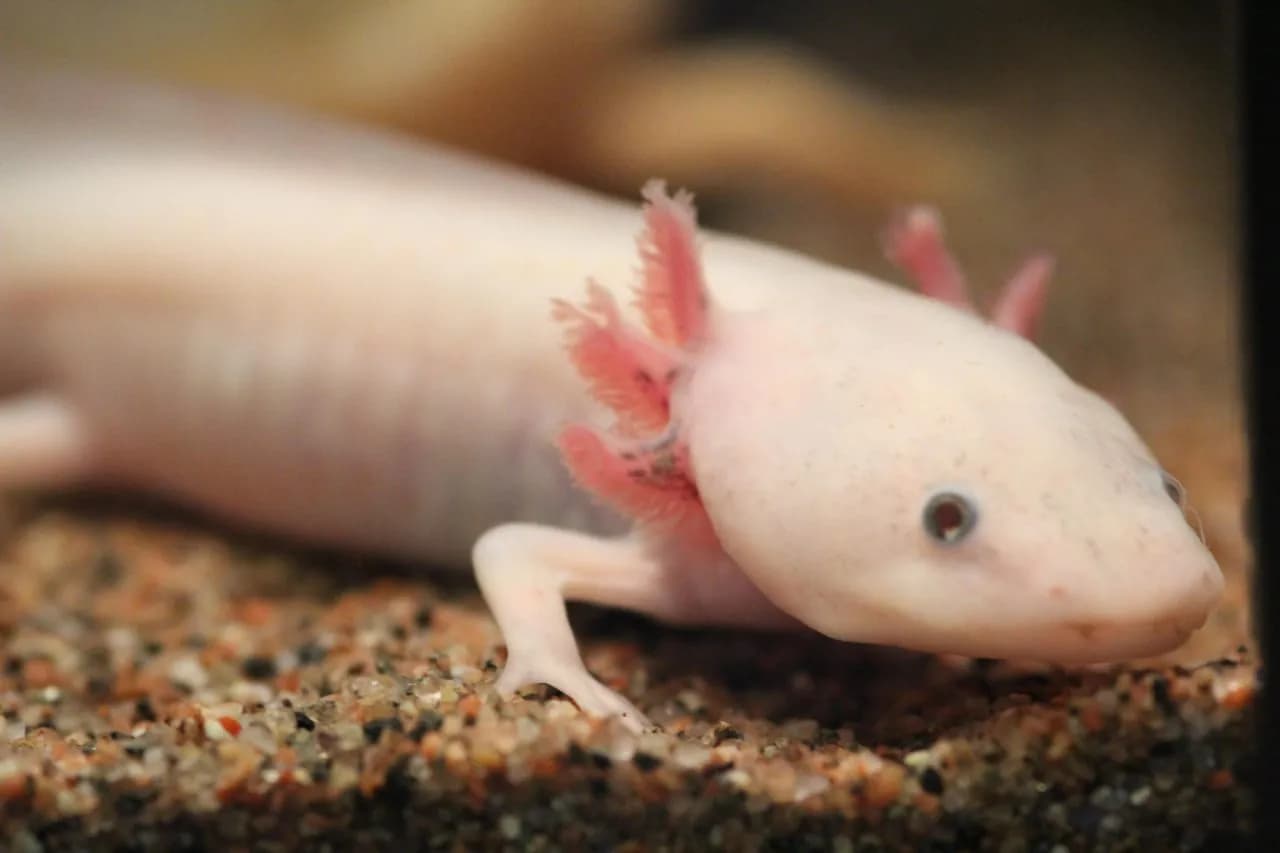
Axolote
An amphibian that retains larval features throughout its life (neoteny). Critically endangered in the wild. Colour varieties developed in captivity.
Foto: Wikipedia Commons · CC BY-SA
Mizuu editorial teamupdated on October 14, 2026Not yet reviewed by a vet. Are you a vet? Review itReport an error
Ideal for
- Anyone seeking an exotic pet with a technical commitment
- Patient people (reptiles need time to build trust)
- Homes with space for a terrarium
Reconsider if
- ×Homes with young children without supervision
- ×People with no prior experience (consult an exotic vet first)
- ×Life spent entirely in a small terrarium (cruel)
Notify me when a Axolote is up for adoption
We'll only email you when a verified rescue posts one available. No spam, unsubscribe in 1 click.
We'll only use your email for this alert. More info in our privacy policy.
Is the Axolote a good match for you?
Indicative rating from 1 (low) to 5 (high).
Estimated cost of ownership
20-40 €/month
Food (worms/pellets) 6-12 € + filter/cooling electricity 8-18 € + water conditioners and water changes 5-10 €.
History and origin
The axolotl (Ambystoma mexicanum) is a neotenic salamander endemic to the canals of Xochimilco (Mexico), critically endangered in the wild but widely bred in captivity for its regenerative abilities.
Temperament and character
Reptiles are NOT social like mammals. They tolerate handling but do not seek companionship. Trust is earned with patience.
Living together
Children: depends on species + educational handling. **Other pets:** avoid — bidirectional risk. **Other reptiles:** depending on species, separate terrariums are best.
Life stages of the Axolote
Each stage has its own care priorities. Life expectancy: 10-15 años.
Larva
0-2 months
Fully aquatic neotenic amphibian; cold, chlorine-free water at 16-18 °C with stable parameters; feed with brine shrimp/microworms several times a day and separate by size.
Juvenile
2-8 months
Aquarium with no substrate or with fine sand (to prevent gravel impaction); earthworms and pellets; well-filtered, ammonia-free water.
Subadult
8-18 months
Cool temperature 16-19 °C (never above 22 °C); earthworms, worms and quality pellets; monitor parameters to prevent ammonia/nitrite poisoning.
Adult
1.5-15 years
Cold water 16-18 °C, without strong light or intense currents; carnivorous diet 2-3 times/week; no heat or UVB (aquatic species, sensitive to high temperature).
Care
Terrarium: minimum size according to species (consult species-specific guides). UVB is mandatory for diurnal species.
Temperature: day/night gradient · warm zone vs cool zone for thermoregulation.
Humidity: according to species (rainforest 70%+ · desert 30-50%).
Feeding: species-specific diet · insectivores, herbivores and carnivores vary dramatically.
Veterinary care: exotic vet (a regular vet will NOT do). Annual check-up.
Care in detail
Nutrition
Carnivore: earthworms, axolotl-specific pellets, worms and pieces of fish/prawn. Do not feed live fish (parasites) or mammal meat. Adults every 2-3 days.
Grooming
Fully aquatic: it is not bathed or handled. The 'grooming' consists of keeping the water quality and temperature impeccable.
Training
It is not handled; taking it out of the water or using rough nets damages its scaleless skin. Handle only with a container if strictly necessary.
Exercise
Aquarium of at least 60-80 L per specimen, cold water without strong currents, hiding spots and low light. It needs no UVB or dry area.
Breed-specific health
UVB deficiency (rickets, MBD), parasites, respiratory infections from incorrect humidity. Life expectancy 10-15 years when well cared for.
Health predispositions for this breed
Conditions this breed is more predisposed to. Knowing about them helps with prevention and early detection. A predisposition does not mean the animal will develop them.
Common diseases in reptiles
Learn the symptoms, prevention and when to see the vet. Reviewed indicative information that does not replace a veterinary consultation.
Screening and prevention for the Axolote
Recommended tests and screenings
- Water analysis (ammonia, nitrites, nitrates, pH, temperature)
- Inspection of the external gills and skin
- Skin smear/cytology in case of blemishes or lesions (fungi, bacteria)
- Faecal test in case of regurgitation or weight loss
Prevention
Cold, well-filtered water (keep at 16-18 °C, never above 20-22 °C), a cycled filter and weekly partial water changes. Fine sand substrate or no substrate to prevent impaction. No small gravel.
Check-up schedule
Exotic/aquatic vet for any skin lesion, deteriorated gills or abnormal buoyancy.
Warning signs
- !Shrunken, pale or eroded gills (poor water quality or high temperature)
- !Uncontrolled floating or loss of appetite
- !Cotton-like patches (fungal infection) or ulcers
- !Curved tail or lethargy (thermal stress)
Axolote gallery

Frequently asked questions about the Axolote
How long does a Axolote live?
▾
How much does a Axolote weigh?
▾
Where does the Axolote breed come from?
▾
How much exercise does a Axolote need?
▾
Is the Axolote good with children?
▾
Who is the Axolote NOT recommended for?
▾
What health problems does the Axolote have?
▾
Does the axolotl need heat and UVB like a reptile?
▾
Can it be picked up by hand?
▾
Why should there be no gravel on the bottom?
▾
Can it live with fish?
▾
Learn more about reptiles
Practical veterinary guides to support your Axolote.
Sources and references
Content compiled from official breed standards and leading veterinary sources.
- WikipediaAmbystoma mexicanum (Wikipedia) ↗
- AmphibiaWebAmphibiaWeb — amphibian database ↗
Want to adopt a axolote?
There are axolotes in rescue shelters looking for a family. Filter by breed in the catalogue.

