


Gecko Diurno (Phelsuma)
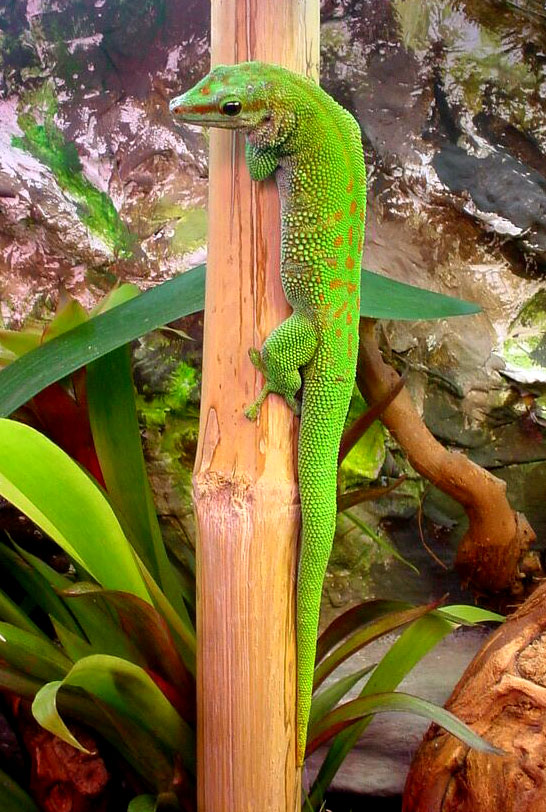
Bright green. Diurnal (rare in geckos). Perfect eyesight.
Foto: Wikipedia Commons · CC BY-SA
Ideal for
- ✓Those seeking an exotic pet with a technical commitment
- ✓Patient people (reptiles need time to build trust)
- ✓Homes with room for a terrarium
Reconsider if
- ×Homes with young children without supervision
- ×People without prior experience (consult an exotics vet first)
- ×A life 100% in a small terrarium (cruel)
Notify me when a Gecko Diurno (Phelsuma) is up for adoption
We'll only email you when a verified rescue posts one available. No spam, unsubscribe in 1 click.
We'll only use your email for this alert. More info in our privacy policy.
Is the Gecko Diurno (Phelsuma) a good match for you?
Indicative rating from 1 (low) to 5 (high).
💶 Estimated cost of ownership
20-35 €/month
Insects + nectar/purée 8-15 € + supplements 2-4 € + UVB/heat electricity 6-12 € + UVB depreciation.
History and origin
Day geckos of the genus Phelsuma, brightly coloured green, native to Madagascar and other Indian Ocean islands; they require UVB owing to their diurnal activity.
Temperament and character
Reptiles are NOT social like mammals. They tolerate handling but do not seek company. Trust is earned with patience.
Living together
Children: depends on the species + supervised handling. **Other pets:** avoid — risk both ways. **Other reptiles:** depending on species, separate terrariums are better.
Life stages of the Gecko Diurno (Phelsuma)
Each stage has its own care priorities. Life expectancy: 10-20 años.
Hatchling/Neonate
0-3 months
Unlike other geckos, it is diurnal: it needs UVB; heat 28-30 °C, high humidity; micro-insects and nectar with calcium.
Juvenile
3-12 months
Small insects and fruit purée/nectar with calcium; humid planted terrarium with UVB.
Subadult
1-2 years
Planted vertical terrarium, quality UVB and a thermal gradient; very delicate skin, minimal handling.
Adult
2+ years
A mixed insect/nectar diet, constant UVB and humidity; monitor the frequent egg-laying in females.
Care
Terrarium: minimum size depending on species (consult species-specific guides). UVB is mandatory for diurnal species.
Temperature: day/night gradient · warm vs cool zone for thermoregulation.
Humidity: depending on species (rainforest 70%+ · desert 30-50%).
Feeding: species-specific diet · insectivores, herbivores and carnivores vary radically.
Veterinary care: exotics vet (a general vet will NOT do). Annual check-up.
Care in detail
🍽️ Nutrition
Insectivorous and nectarivorous: small insects dusted with calcium plus fruit purées/nectar for day geckos. Water by misting.
✂️ Grooming
It is not bathed; humidity and misting ensure complete sheds. Watch the toes.
🎓 Training
An observation species: the skin tears when it is held, so it is NOT handled. Enjoy it in a planted terrarium.
🏃 Exercise
A heavily planted vertical terrarium with bamboo/branches, UVB and a basking spot (28-30 °C), ambient 24-28 °C and humidity 60-70%.
Breed-specific health
Lack of UVB (rickets, MBD), parasites, respiratory infections from incorrect humidity. Life expectancy 10-20 years when well cared for.
🩺 Health predispositions of this breed
Conditions this breed is more predisposed to. Knowing about them helps with prevention and early detection. A predisposition does not mean the animal will develop them.
Common diseases in reptiles
Learn the symptoms, prevention and when to see the vet. Reviewed indicative information that does not replace a veterinary consultation.
Screening and prevention for the Gecko Diurno (Phelsuma)
Recommended tests and screenings
- ✓Faecal exam (parasites)
- ✓MBD assessment
- ✓Skin inspection (it is very delicate and tears)
- ✓Hydration and shedding monitoring
Prevention
UVB is mandatory (diurnal species), renewed every 6-12 months, along with calcium/D3 and hydration by misting. Minimal handling: the skin is fragile and tears easily.
Check-up schedule
Check-up with an exotics vet at acquisition and annually.
Warning signs
- !Soft jaw or tremors (MBD)
- !Wounds or skin tears from handling
- !Retained shed on the toes
- !Lethargy and sunken eyes (dehydration)
Gecko Diurno (Phelsuma) gallery
Frequently asked questions about the Gecko Diurno (Phelsuma)
How long does a Gecko Diurno (Phelsuma) live?
▾
How much does a Gecko Diurno (Phelsuma) weigh?
▾
Where does the Gecko Diurno (Phelsuma) breed come from?
▾
How much exercise does a Gecko Diurno (Phelsuma) need?
▾
Is the Gecko Diurno (Phelsuma) good with children?
▾
Who is the Gecko Diurno (Phelsuma) NOT recommended for?
▾
What health problems does the Gecko Diurno (Phelsuma) have?
▾
Why should it not be handled?
▾
Does it need UVB?
▾
What does it eat besides insects?
▾
Is it unusual for a gecko to be diurnal?
▾
Learn more about reptiles
Practical veterinary guides to support your Gecko Diurno (Phelsuma).
Sources and references
Content compiled from official breed standards and leading veterinary sources.
- WikipediaPhelsuma ↗
- The Reptile DatabaseReptile Database ↗
- AHESpanish Herpetological Association ↗
Want to adopt a gecko diurno (phelsuma)?
There are gecko diurno (phelsuma)s in rescue shelters looking for a family. Filter by breed in the catalogue.